
AUTHORISED INVISALIGN® PROVIDER · YELAHANKA
Crooked, Crowded or Forward Teeth?
Straighten Your Smile Without Letting Braces Take Over Your Life.
Whether your teeth overlap, stick forward, have gaps, your bite feels wrong, or your teeth have shifted after previous braces — the first step is finding out why.
At GardenCity Smiles, Dr. Deepthi Kalahasti evaluates your smile, bite and dental arches before deciding whether Invisalign clear aligners are the right solution for you.
- No treatment pressure
- Digital assessment
- Clear explanation of options

- Digital Invisalign Planning
- iTero™ 3D Scan In-House
- Personalised Treatment Plan
- Doctor-Supervised Care
- Authorised Invisalign® Provider
Authorised Invisalign® Provider
Doctor-supervised clear aligner treatment.
iTero™ 3D Scanning In-House
Digital impressions and treatment visualisation.
Dr. Deepthi Kalahasti
American Board Certified Orofacial Pain Specialist.
Yelahanka, Bengaluru
Advanced digital dentistry under one roof.
Start Here
What Is Actually Bothering You About Your Teeth?
You don’t need to know the dental terminology. Start with what you see or feel.
🦷
My teeth look crowded or overlap
There doesn’t seem to be enough space for all my teeth.
Crowding
Understand Crowded Teeth
😬
My front teeth stick out
My upper front teeth look too prominent from the front or side.
Forward Teeth / Increased Overjet
Understand Forward Teeth
↔️
I have gaps between my teeth
I notice spaces between one or more teeth.
Spacing / Diastema
Understand Teeth Gaps
🔄
My bite doesn't feel right
My upper and lower teeth don’t meet comfortably.
Deep Bite / Open Bite / Crossbite
Understand Bite Problems
↩️
My teeth moved after braces
My teeth were straight before, but they have gradually shifted.
Orthodontic Relapse
Can They Be Corrected Again?
😌
I want straight teeth without metal braces
I want something discreet that works with my professional and social life.
Discreet Treatment
Explore Clear Treatment Options
🪥
I find crooked teeth difficult to clean
Food gets trapped and some areas are difficult to brush or floss.
Hygiene & Health
See Why Alignment Matters
👨👩👧
I'm worried about my child's developing smile
Crowding, forward teeth, bite problems or narrow dental arches are becoming noticeable.
Early Orthodontics
Explore Early Orthodontic Assessment
Can Crooked Teeth Be Straightened Without Metal Braces?
Often, yes. Many cases of crowded teeth, spacing, forward teeth and certain bite problems can be treated with clear aligners such as Invisalign. Suitability depends on the type and severity of tooth and jaw movement required, gum health, age and treatment goals. A clinical examination and digital scan are necessary before recommending treatment.
Clear aligners work by applying gentle, controlled forces to move teeth incrementally using a series of custom-fitted transparent trays. Each set of aligners is worn for a prescribed period before advancing to the next stage of treatment.
Not all orthodontic problems are suitable for clear aligner treatment. Complex skeletal problems — where the jaw itself is not positioned correctly — typically require additional treatment approaches. This is why diagnosis must come before any recommendation.
“We don’t begin with Invisalign. We begin with your problem.”
— GardenCity Smiles approach to orthodontic assessment
Clinical Insight
Why Correcting Teeth Alignment Can Matter Beyond Your Smile
Straight teeth are the visible result. A correctly planned bite is the foundation.
Cleaning Difficulties
Overlapping teeth may make brushing and flossing more difficult and allow plaque to remain in inaccessible areas.
Tooth Wear
An unfavourable bite can place excessive forces on certain teeth over time.
Chewing
Some bite problems can affect the way teeth contact during chewing and jaw function.
Gum Health
Cleaning crowded or overlapping teeth can be consistently challenging, affecting gum health.
Jaw & Bite Function
Tooth position and bite relationships should be evaluated as part of the overall dental examination.
Confidence
Many patients simply avoid smiling openly because they dislike the appearance of their teeth.
“The goal isn’t simply straighter front teeth. It is a smile that looks good and functions well.”
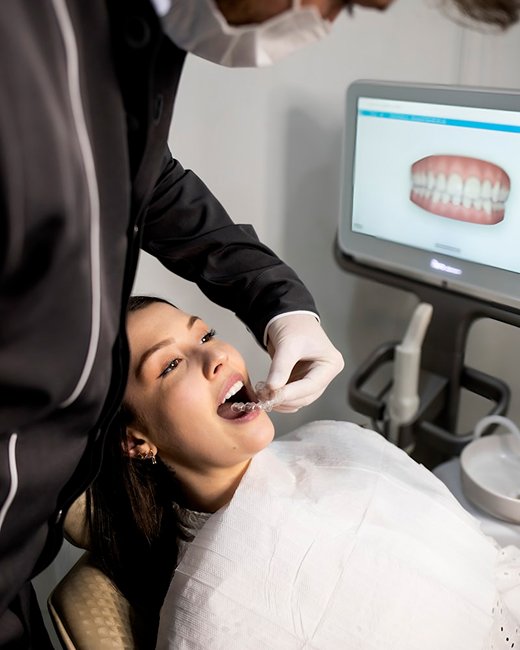
Suitability Guide
Could Invisalign Work for Your Problem?
Starting with the patient’s experience, not the dental textbook.
“My teeth look crowded — there’s no room for them all”
- Crowding
“Some of my teeth twist or lean to one side”
- Crooked / Rotated Teeth
“Two of my teeth seem to sit on top of each other”
- Overlapping Teeth
“I have a noticeable gap between my front teeth”
- Spacing / Diastema
“My upper front teeth stick out too far”
- Forward Teeth / Increased Overjet
“My upper teeth cover too much of my lower teeth”
- Deep Bite / Overbite
“My front teeth don’t touch when I bite down”
- Open Bite
“My upper and lower teeth cross on one side”
- Crossbite
“My lower teeth seem to be in front of my upper teeth”
- Certain Underbites
“My upper arch looks narrow compared to my lower teeth”
- Narrow Dental Arch (selected cases)
“My teeth were straight then moved again after treatment”
- Orthodontic Relapse
“My case was told to be complex — can aligners still help?”
- Selected Complex Cases
Important: Not every orthodontic problem can or should be treated with clear aligners. Complex skeletal or dental problems may require braces, additional appliances, multidisciplinary treatment or surgery. Suitability is determined after diagnosis — never before.
Not Every Crooked Tooth Needs Invisalign.
And not every person who wants Invisalign should receive it.
The treatment system is only one tool. Diagnosis determines the treatment. At GardenCity Smiles, we first assess your teeth, gums, bite, dental arches and treatment objectives. If another treatment would give you a better or more predictable result, we will explain that.
In-House Technology
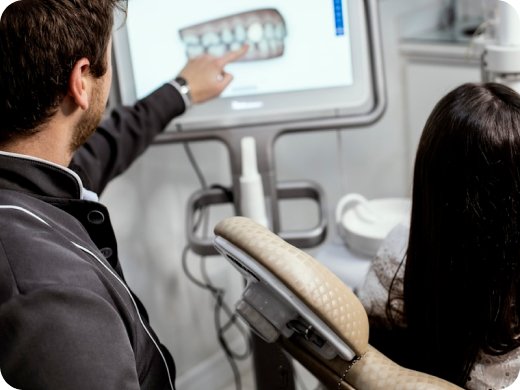
See Your Teeth in 3D Before Treatment Begins
In-House iTero™ Digital Scanning
Instead of relying only on conventional impressions, the iTero scanner creates a detailed digital model of your teeth and bite. This gives Dr. Deepthi Kalahasti precise information to plan your treatment.
Having this technology in-house at GardenCity Smiles means your assessment and planning can begin without additional referrals or appointments at an external facility.
“Digital technology improves the information available to your dentist. It does not replace clinical judgement.”
01
Scan
Capture a detailed digital model of the teeth and bite without impression materials.
02
Analyse
Evaluate crowding, spacing, tooth position and bite relationships precisely.
03
Plan
Use the digital records as part of personalised Invisalign treatment planning.
04
Visualise
Help you understand proposed tooth movement and likely treatment objectives.
Your Doctor
Your Invisalign Treatment Is Planned by a Doctor — Not an Algorithm
Meet Dr. Deepthi Kalahasti
- Founder & Director, GardenCity Smiles
- American Board Certified in Orofacial Pain
- Advanced training in TMJ & Orofacial Pain Management
- Digital Dentistry & CAD/CAM specialist training
- Authorised Invisalign® Provider
“My job is not to sell you aligners. My job is to understand why your teeth and bite are the way they are, explain your options clearly, and recommend the treatment that makes clinical sense.”
— Dr. Deepthi Kalahasti (proposed statement — pending approval)
Doctor-led diagnosis · Personalised planning · In-person supervision


For Adults
Want Straighter Teeth Without Looking Like You're Wearing Braces?
Many adults postpone orthodontic treatment because they do not want fixed metal braces to become part of their professional or social identity. Clear removable aligners can make treatment less visually intrusive for suitable cases — whether you’re in client meetings, giving presentations, attending weddings or photographed at social events.
- Removable for eating
- Digital planning
- Designed around everyday life
- Nearly transparent appearance
- Doctor-supervised treatment
- No dietary restrictions
High-Intent Concern
Had Braces Before — But Your Teeth Have Moved Again?
Orthodontic relapse is common enough that many adults notice crowding, rotations or spacing returning years after previous treatment. This is not necessarily a reflection of poor original treatment — teeth have a natural tendency to shift, and retention is essential to preserving any orthodontic result.
Clear aligners are well-suited to correcting mild-to-moderate relapse. The approach at GardenCity Smiles includes assessing what caused the relapse in the first place, so a better retention plan can be built into the new treatment.
- Assessment of current tooth position
- Existing retainer assessment
- Clear aligner correction when suitable
- Bite evaluation
- Digital iTero scan
- New personalised retention plan
For Families
Worried About Your Child's Developing Teeth or Bite?
Signs that prompt parents to seek an orthodontic assessment include front teeth sticking forward, crowding that becomes visible as permanent teeth erupt, crossbite, teeth not meeting properly, and a narrow-looking upper arch.
Early assessment allows Dr. Deepthi Kalahasti to determine whether treatment is required immediately, whether monitoring is appropriate, or whether treatment should wait until more permanent teeth have erupted.
- Front teeth sticking forward
- Crossbite
- Narrow upper arch
- Early loss of baby teeth
- Crowding as permanent teeth erupt
- Teeth not meeting properly
- Mouth breathing pattern
- Difficulty biting certain foods
What if my child mouth-breathes or snores?

Informed Decision
Clear Aligners Are Not All the Same — And Neither Is the Planning
The aligner is only part of treatment. Diagnosis, planning, monitoring and patient cooperation influence the final result.
| Consideration | GardenCity Smiles Invisalign Care |
|---|---|
| Initial diagnosis | In-person clinical examination |
| Records | In-house iTero digital scan |
| Treatment system | Invisalign® |
| Planning | Dentist-led by Dr. Deepthi Kalahasti |
| Bite evaluation | Included in assessment |
| Monitoring | In-person clinical reviews |
| Refinements | Based on clinical requirements |
| Retention | Planned after active treatment |
| Complex problems | Reassessed rather than automatically accepted |
Your Pathway
From "Can My Teeth Be Fixed?" to a Planned New Smile
01
Tell Us What Is Bothering You
Smile, bite, crowding, gaps, relapse, discomfort or appearance — tell us in your own words.
02
Clinical Examination
Assessment of teeth, gums, bite and dental relationships by Dr. Deepthi Kalahasti.
03
iTero 3D Digital Scan
A detailed digital model of the teeth and bite captured in-house at GardenCity Smiles.
04
Diagnosis & Options
Determine whether Invisalign, another orthodontic approach, or no treatment is appropriate.
05
Digital Treatment Planning
Plan tooth movements and treatment objectives using precision digital tools.
06
Your Aligners
Receive personalised clear aligners where clinically indicated.
07
08
A personalised retention plan to protect the corrected result long-term after treatment.
Patient Outcomes
Real Smiles. Real Treatment Plans.
Genuine before-and-after cases from GardenCity Smiles patients. Full cases will be published with written patient consent and doctor approval.
Before / After Photo
Published with patient consent
Concern
Crowded lower teeth
Diagnosis
Moderate crowding with mild rotation
Treatment
Invisalign Comprehensive
Duration
14 months
Doctor
Dr. Deepthi Kalahasti
Before / After Photo
Published with patient consent
Concern
Gap between front teeth
Diagnosis
Moderate crowding with mild rotation
Treatment
Invisalign Lite
Duration
9 months
Doctor
Dr. Deepthi Kalahasti
Before / After Photo
Published with patient consent
Concern
Teeth shifted after braces
Diagnosis
Orthodontic relapse — mild crowding
Treatment
Invisalign Moderate
Duration
11 months
Doctor
Dr. Deepthi Kalahasti
Transparent Pricing
What Determines the Cost of Invisalign Treatment?
Invisalign treatment cost depends on the complexity of the orthodontic problem, number of tooth movements required, treatment duration, aligner programme and whether additional procedures are necessary. An accurate fee can only be provided after assessing the teeth and bite.
Simple correction
Minor spacing or crowding with limited movement
Shorter treatment
Moderate correction
Multiple teeth, rotations, bite involvement
Mid-range treatment
Complex correction
Bite problems, significant movement, multiple arches
Longer treatment
An accurate fee for your specific case can only be confirmed after a clinical examination and iTero scan at GardenCity Smiles. Fee is not determined by simple correction alone — the bite and supporting structures are also considered.
Patient Reviews
What Patients Say About GardenCity Smiles
Reviews are from verified Google patients. LIVE GOOGLE RATING TO BE INTEGRATED HERE
Patient Questions
Questions Patients Ask Before Straightening Their Teeth
Every answer is written to give you accurate, useful information — not to push you towards treatment.
Often, yes. Many cases of crowded, crooked or overlapping teeth can be treated with clear aligners such as Invisalign. Suitability depends on the type and severity of tooth movement required, gum health, age and treatment goals. A clinical examination and digital scan are necessary before recommending treatment.
Treatment depends on the degree of overlap and the underlying cause. Mild-to-moderate overlapping can often be corrected with clear aligners. More severe crowding may require additional procedures. An in-person assessment is needed to recommend the most appropriate approach.
Many cases of forward or protruding teeth can be corrected without traditional metal braces using clear aligners. Whether Invisalign is suitable depends on whether the problem comes primarily from tooth position, jaw relationship or both. A dentist needs to assess the bite and supporting structures before choosing treatment.
Take the First Step
You Don't Need to Decide Whether You Need Invisalign.
That’s What the Assessment Is For.
Tell us what bothers you about your smile or bite. We’ll examine the problem, digitally scan your teeth when appropriate, explain your options and tell you honestly whether clear aligners make sense.
Call us
Hours
Mon–Sat 9:30 AM – 7:30 PM · Sun by appointment
GardenCity Smiles · Yelahanka New Town · Bengaluru
Request My Assessment
No treatment pressure. Just an honest conversation about your teeth.
No treatment pressure · Doctor-supervised · GardenCity Smiles